


An empire is a large state or group of countries that are governed by a single ruler or government. Empires typically consist of various peoples, cultures, and languages, united by force or policy. A key feature of an empire is its ability to control vast territories and influence international politics.
Signs of an Empire
-
Centralized Power: An empire has a strong center of governance, often concentrated in the capital or in the hands of a single ruler, such as an emperor.
-
Territorial Expansion: Empires seek to conquer and annex new lands. This can be achieved through military means or diplomacy.
-
Cultural Dominance: Empires often impose their culture, language, and religion on subjugated peoples.
-
Economic Exploitation: Subjugated territories are usually used for the economic benefit of the center of the empire.
-
Military Might: Empires maintain powerful armies to defend their borders and suppress uprisings.
What Empires Exist in History?
History knows many examples of empires that have left their mark on the world map:
-
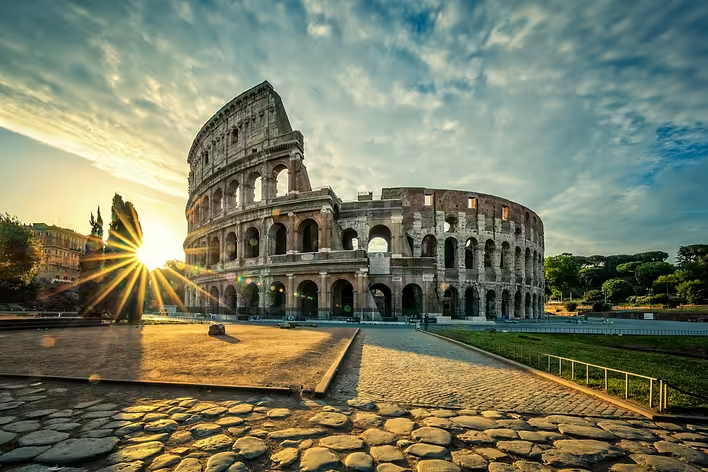
Roman Empire: One of the most famous and influential empires of antiquity, stretching from the British Isles to the Middle East.
-
British Empire: Once “the empire on which the sun never sets,” it included colonies on all continents.
-
Ottoman Empire: Controlled significant parts of Europe, Asia, and Africa for several centuries.
-
Mongol Empire: The largest contiguous empire in history, founded by Genghis Khan.
Is There a Single Empire in the World?
Today, it is difficult to name any country as “the only empire in the world.” Although some major powers have significant influence on the international stage, they do not meet all the classical characteristics of empires of the past. However, the term “empire” is sometimes used to describe the economic or cultural hegemony of modern superpowers.
Interesting Facts About Empires
- The Roman Empire was so vast that it had different time zones.
- The British Empire encompassed nearly a quarter of the world's population at its peak.
- The Ottoman Empire lasted over 600 years before its dissolution after World War I.
Empires have left an important mark on human history. They shaped the borders of countries, influenced the development of cultures, and even determined the fate of entire nations. Although classical empires no longer exist, their influence is still felt today.
Therefore, if you are interested in history or want to understand the modern world order, knowledge about what an empire is and its characteristics will be useful to you. This will help you better navigate how geopolitical processes are formed and what lessons we can learn from the past for the future.