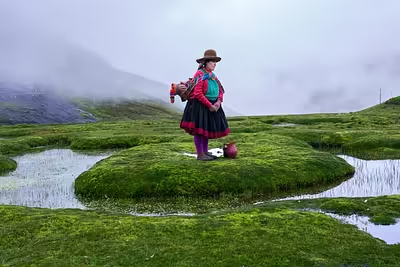
The clothing of the Aymara people аймара is not just protection against the harsh climate of the Andes, but a complex system of symbols, social codes, and cultural memory. It intertwines ancient traditions, colonial influences, and modern forms of self-expression. What is often referred to today as a "traditional costume" is actually the result of a long history — with elements of coercion, adaptation, and reinterpretation.
Pre-Colonial Roots
Before the arrival of Europeans, the Aymara made clothing from the wool of alpacas, llamas, and vicuñas. Fabrics were created by hand on simple looms, and weaving was not just a craft but an important part of the culture passed down from generation to generation.
The wardrobe consisted of tunic-like shirts, capes, belts, and headwear. The clothing was practical, adapted to mountain conditions, yet rich in symbolism. Patterns and colors could indicate a person's origin, their community, family status, or even life stage.
Dyes were obtained from natural sources: plants, minerals, and insects. For example, red shades were achieved using cochineal — an insect that has been used since ancient times.
Colonial Period: Clothing as a Tool of Control
With the arrival of the Spaniards in the 16th century, clothing became a tool of social differentiation. Colonial authorities imposed certain types of clothing on the indigenous population to clearly distinguish them from Europeans and reinforce hierarchy.
It was during this time that elements now considered "traditional" but of European origin emerged. Women were forced to wear wide, multi-layered skirts, blouses, and hats — this was meant to emphasize their subordinate position in society.
However, over time, these elements not only took root but were reinterpreted. The Aymara integrated them into their own culture, giving them new meaning and symbolism.
Pollera, Hat, and the Image of Cholita
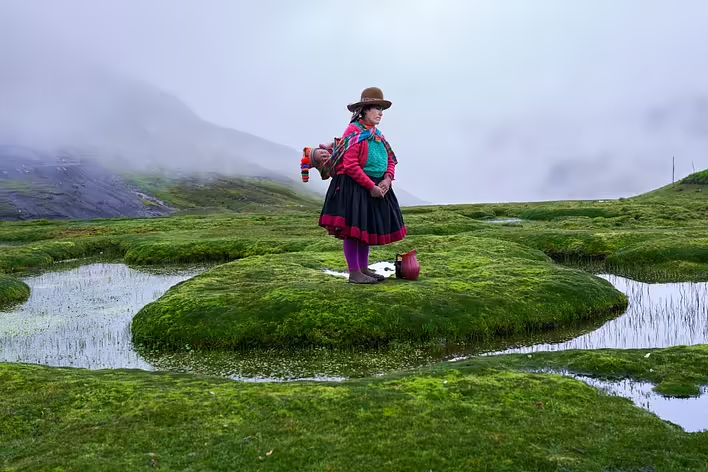
One of the most famous elements of women's clothing is the pollera — a wide, multi-layered skirt. Initially, it was a symbol of colonial oppression, but over time it transformed into a sign of identity and even prestige.
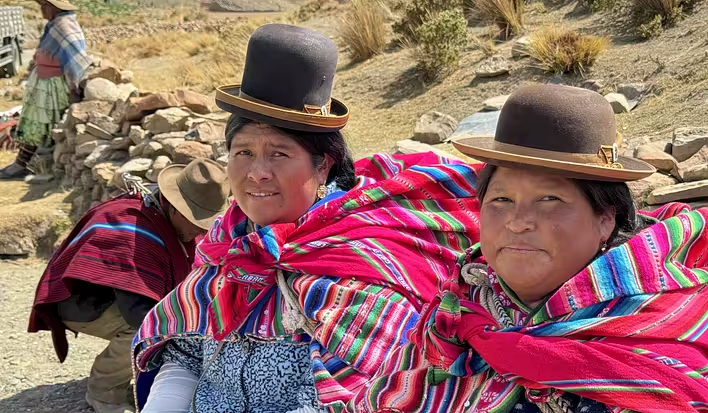
Today, women often referred to as cholitas wear polleras along with elegant shawls and hats. Their image is recognizable and at the same time very variable.
Hats have an interesting history: they follow the European fashion of the 19th century, but in different regions have acquired their own forms and meanings. For example, the way a hat is worn or its tilt can signal a woman's marital status.
Importantly, today cholitas are not just bearers of tradition but also active participants in modern life: they engage in business, politics, and community activities. Their clothing has become a symbol of strength, self-respect, and social ascent.
Aymara Patterns: A Woven Language of Symbols
The patterns in Aymara clothing are not just decorative elements, but a complex system of visual communication. They can be compared to a language that is "read" within the community: through the patterns, one can recognize a person's origin, their status, and even life experience.
Most patterns are geometric in nature — diamonds, zigzags, steps, stripes. But behind this apparent simplicity lies deep symbolism. For example, the diamond is often associated with the concept of the universe or fertility, while zigzags may symbolize water, lightning, or mountainous terrain.
Importantly, the patterns are not universal — each region has its characteristic motifs. This means that an experienced person can determine where the owner of the clothing comes from just by the fabric's design. Such "regional identification" is particularly noticeable in aguayo — traditional fabrics that often serve as both shawls and bags.
A separate role is played by composition. Patterns are not arranged randomly: they have a clear structure, where central stripes may symbolize core life values, while side ones complement the story. In some cases, a pattern may even reflect a worldview — a division into upper, earthly, and underworld realms.
Color also works in conjunction with form. The same pattern in different colors can have different shades of meaning. For example, bright combinations are often used for festive clothing, while more subdued ones are for everyday wear.
Interestingly, patterns can change over time. Artisans add new elements, experiment with colors, but at the same time maintain the basic structure. Thus, tradition does not remain static — it evolves without losing its recognizability.
In a modern context, Aymara patterns increasingly transcend traditional clothing. They can be seen in contemporary design, fashion, and even urban spaces. However, for the Aymara themselves, these patterns remain primarily carriers of memory — they contain stories that are not written in words but preserved in fabric.
Modernity: Between Tradition and Globalization
In the 21st century, Aymara clothing has not disappeared or turned into a museum exhibit. On the contrary, it continues to change. Young people often combine traditional elements with modern clothing — for example, wearing jeans along with a traditional shawl or jewelry.
This approach does not destroy tradition but demonstrates its flexibility and ability to adapt. Clothing becomes a way to assert one's identity in the modern world without renouncing one's roots.
The most interesting aspect of the history of Aymara clothing is its transformation. What was once imposed as a sign of subordination can today signify pride and self-respect.
This process shows how culture is capable not only of preservation but also of reinterpreting even complex and painful pages of its history.